Uncertainty Quantification on AKAR4 (deterministic model)
sampleAKAR4.RmdLoad Model and Data
The first step is to locate and load the model files (TSVs). In this example we use the SBtab files from an already existing example (“AKAR4”).
The Sample AKAR4 with Parallel Tempering shows how to use MPI and parallel tempering for this model.
In the article “Build and simulate your own
Model you can read about how the set up your own model files. You
can list the files in a directory with the dir()
command.
f <- uqsa_example("AKAR4")
m <- model_from_tsv(f)
o <- write_and_compile(as_ode(m))
The chain of functions that we use to build the model tracks the name of the model via comments:
This comment is ultimately used to determine the automatic file-name of the shared library.
ex <- experiments(m,o)Take a parameter Sample for this Model
We use just one core as this is a tiny model. No MPI, no parallel tempering. First we construct the prior:
mu <- values(m$Parameter)
sigma <- m$Parameter$stdv

dprior <- dNormalPrior(
    mean=log(mu^2/sqrt(mu^2+sigma^2)),
    sd=log(1+sigma^2/mu^2)
)
rprior <- rNormalPrior(
    mean=log(mu)/sqrt(mu^2+sigma^2),
    sd=log(1+sigma^2/mu^2)
)
Next, the MCMC method via metropolis_update, which
determines the sampling algorithm we are going to use. Finally, we
construct the sampler (MH below), which actually performs
the MCMC run, this function takes the initial values, number of steps
and the stepsize as arguments.
opt <- options(mc.cores=length(ex))
s <- simulator.c(
    ex,
    o,
    parMap=logParMap,
    omit=2
)

MH <- mcmc(
    metropolis_update(
        s,
        dprior=dprior
    )
)
Finally, to obtain a sample of parameters:
x <- mcmc_init(
    beta=1.0,
    parMCMC=log(values(m$Parameter)),
    simulate=s,
    dprior=dprior
)

h <- tune_step_size(MH,x,h=1e-3)
N <- 5e4

# sampling:
X <- MH(x,N,eps=h)

print(attr(X,"acceptanceRate"))
#> [1] 0.45934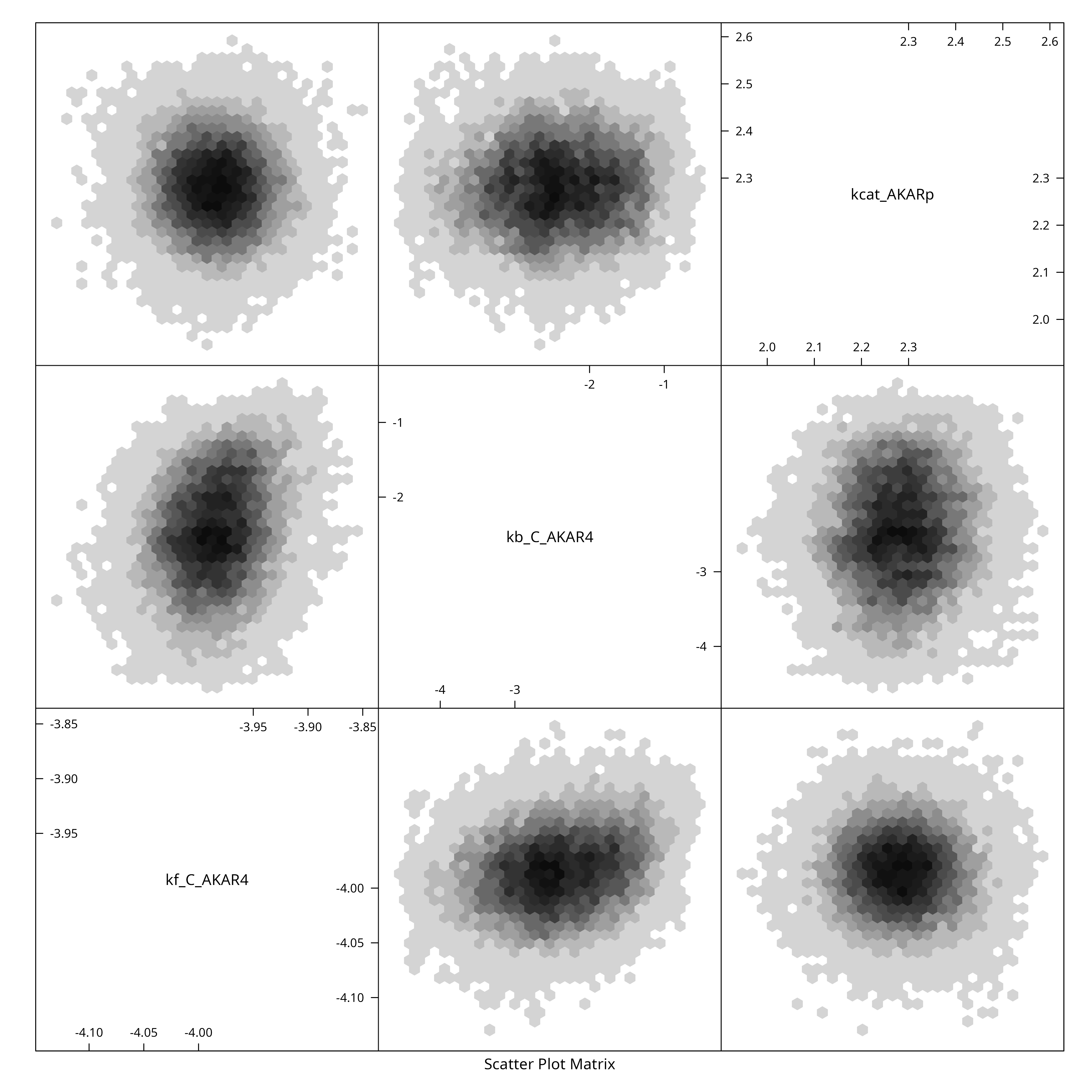
Better Sample
We can try to obtain a higher quality sample, through simple means:
- Combine several samples (replicas) into one big sample
- Use several random starting locations
- Remove burn-in phase from each chain
- Adjust the step size at least once to get close to 25% acceptance rate
Restore original options:
options(opt)