Plot time series simulation with state variables
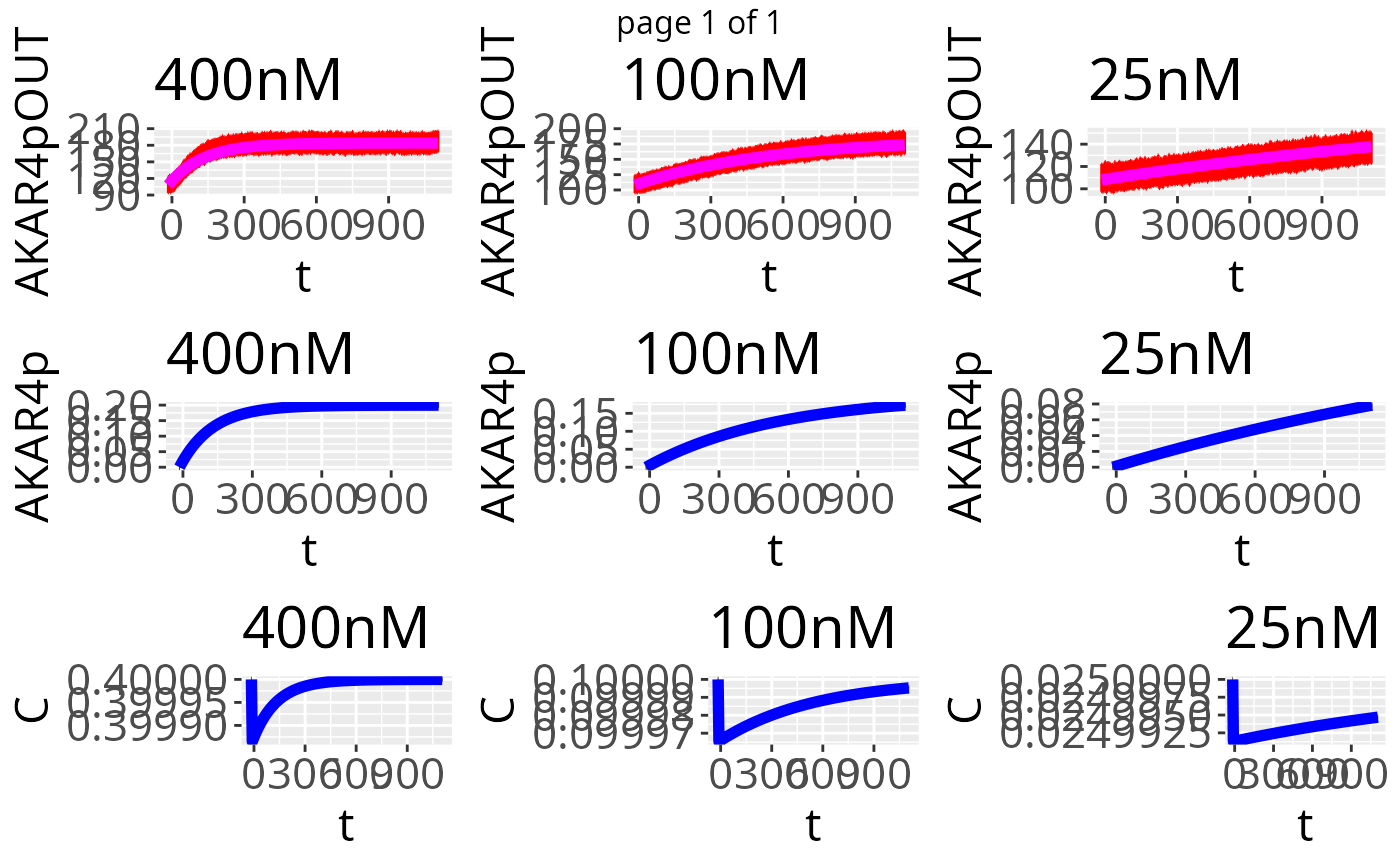
ggplot_time_series_states.RdThis function plots simulations of time series experiments and plots them against experimental data. The input in the provided experiments must differ only in one vector component.
Usage
ggplot_time_series_states(
  simulations,
  experiments,
  var.names = NULL,
  type = "boxes",
  plot.states = TRUE,
  ttf = identity,
  xl = "t",
  yl.func = NULL,
  yl.state = NULL,
  MLE = 1
)
Arguments
- simulations
list of simualtions as output from the simulator
- experiments
list of experiments
- var.names
override the rownames of the simulation results
- type
'boxes' or 'lines'
- plot.states
TRUE (or FALSE) - whether to plot the state variables or only the functions
- ttf
time transformation function - the plot will be against ttf(t), where
tis a vector of the experiment's output times, ttf can adjust the time vector if it is very uneven or requires other modification only when plotting, e.g.seq_along.- xl
x-axis label (time usually)
- yl.func
y-axis-limits of function plots, can be a list of ggplot2::ylim() objects, with NULL elements for automatic mode (the neutral element), NA elements will trigger tight bounds based on the maximum likelihood estimate and data. a simple numeric vector will be interpreted as quantiles for the quantiles function, the first and last quantile of the simulations will be used as ylim()
- yl.state
y-axis-limits for state variable plots, with similar rules as for yl.func
Examples
# \donttest{
m <- model_from_tsv(uqsa_example("AKAR4"))
o <- write_and_compile(as_ode(m))
ex <- experiments(m,o)
s <- simulator.c(ex,o)
p0 <- values(m$Parameter)
y <- s(p0)
ggplot_time_series_states(y,ex)
#> Warning: In 'Ops' : non-'errors' operand automatically coerced to an 'errors' object with no uncertainty
 # }
# }